
Washington State Flag: Design, Symbolism & Why It's Unique
Jan 6th 2026
Some flags shout.
Some flags whisper.
The Washington State Flag does something different, it speaks with quiet authority.
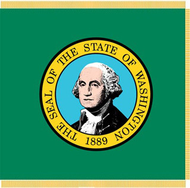
If you’ve ever seen it flying outside a government building, school, or parade route, you probably noticed one thing right away. It doesn’t look like most state flags. There are no busy scenes. No crowded symbols. Just deep green, a seal, and a familiar face.
That simplicity is exactly what makes the Washington State Flag stand out.
This flag isn’t meant to impress with noise.
It’s meant to represent permanence, leadership, and identity.
And for the people of Washington, it does that job well.
A Brief History of the Washington State Flag
Washington became the 42nd state in 1889.
But surprisingly, the Washington State Flag didn’t officially exist until 1923.
For decades, the state had no formal flag. Government buildings used the state seal when needed. But as state pride grew and public ceremonies became more formal, lawmakers realized Washington needed a proper banner.
In 1913, legislation was introduced to create a state flag.
Ten years later, the final version was approved.
The result was a design that reflected Washington’s values: calm strength, respect for leadership, and connection to history.
Why the Washington State Flag Is Green
Washington is the only U.S. state with a green field.
 State and Territorial Flags: Indoor/Parade Use, Nylon
That choice wasn’t random.
Green represents:
- Evergreen forests
- Natural resources
- Growth and renewal
- Stability
Washington is known as “The Evergreen State.”
So the color made sense.
The green background gives the Washington State Flag a grounded look. It feels steady. Natural. Permanent. Unlike bright reds or blues, green doesn’t compete for attention. It holds it.
The Central Seal: More Than Decoration
At the center of the Washington State Flag is the state seal.
The seal features:
- George Washington’s profile
- A gold ring
- The words “The Seal of the State of Washington”
- The year “1889”
The seal isn’t printed casually. It is meant to be precise and respectful. On quality flags, it’s fully detailed and centered.
This seal makes the flag formal.
It tells you this banner belongs in official spaces.
Why George Washington Is on the Flag
Washington is the only state named after a U.S. President.
So it’s fitting that George Washington appears on the Washington State Flag.
But this isn’t about hero worship.
It’s about values.
George Washington represents:
- Leadership without ego
- Duty over ambition
- Stability during uncertainty
Placing him on the flag connects the state to the principles that helped form the nation itself.
It also reminds viewers that Washington state wasn’t named for geography.
It was named for a character.
Symbolism Behind the Design
Every part of the Washington State Flag has meaning.
- Green field: Natural strength and longevity
- Gold seal ring: Authority and official recognition
- George Washington’s image: Leadership and integrity
- Minimal layout: Focus, clarity, and seriousness
Unlike flags that try to tell a full story visually, Washington’s flag makes one clear statement: This state knows who it is.
Why the Washington State Flag Is Considered Unique
Most state flags follow one formula:
Blue background.
Complex seal.
Crowded design.
The Washington State Flag breaks that mold.
Here’s why it stands out:
- Only green state flag in the U.S.
- Only state flag featuring a U.S. President
- Clean, uncluttered layout
- Recognizable from a distance
That uniqueness makes it ideal for:
- Ceremonial use
- Government buildings
- Educational settings
- Parades and official displays
It doesn’t get lost in a lineup of flags.
It holds its ground.
How the Washington State Flag Is Used Today
You’ll see the Washington State Flag in many official and public spaces.
Common display locations include:
- State capitol buildings
- City halls and courthouses
- Public schools and universities
- Military and veterans’ events
- State parades and ceremonies
It’s often flown alongside:
- The U.S. flag
- Other state flags
- Military branch flags
When displayed properly, it signals respect for state identity and authority.
Proper Display Guidelines
Displaying the Washington State Flag correctly matters.
Key rules include:
- Never flown higher than the U.S. flag
- Positioned to the viewer’s left when displayed with the U.S. flag
- Kept clean and undamaged
- Raised and lowered with care
For indoor use, the flag is often mounted on:
- Poles with gold fringe
- Stands with weighted bases
These details may seem small.
But in formal settings, they matter.
Materials Used in Quality Washington State Flags
Not all flags are created equal.
High-quality Washington State Flag options are usually made from:
- Nylon for outdoor durability
- Polyester for heavy wind exposure
- Cotton or satin for indoor ceremonial use
Printed versions are common, but embroidered seals offer:
- Better depth
- Longer lifespan
- More formal appearance
For institutions, durability and accuracy are key.
This is not a decorative item, it’s a symbol.
Indoor vs Outdoor Washington State Flags
Indoor flags are designed for presentation.
- Rich fabric
- Fringe options
- Pole sleeves
Outdoor flags are built for exposure.
- Reinforced stitching
- Weather-resistant dyes
- Strong grommets
Choosing the right Washington State Flag depends on where and how it will be displayed.
Why the Flag Matters to Washington Residents
For residents, the Washington State Flag isn’t just government branding.
It represents:
- Local identity
- Shared values
- Regional pride
From school assemblies to civic events, the flag connects people to place.
It reminds them that Washington is more than cities and landscapes.
It’s a shared responsibility.
Educational Importance of the Washington State Flag
In classrooms, the Washington State Flag plays a role in civic education.
Students learn:
- State history
- Symbolism
- Respect for public institutions
Seeing the flag daily builds familiarity.
Understanding its meaning builds respect.
Collecting and Preserving State Flags
Collectors value the Washington State Flag for its distinctive look.
Vintage versions, especially older printed seals or early designs, are sought after. Preservation requires:
- Controlled indoor storage
- Proper folding
- Avoiding light damage
A well-kept flag can last generations.
Why Glendale Parade Store Is a Trusted Source
When ordering a Washington State Flag, accuracy matters.
Size.
Color.
Seal placement.
Material.
Glendale Parade Store understands ceremonial standards. Their flags are designed for:
- Schools
- Government institutions
- Veterans’ organizations
- Professional displays
This is not novelty merchandise.
It's the official presentation gear.
Final Thoughts: A Flag That Reflects Leadership
The Washington State Flag doesn’t rely on spectacle.
It relies on meaning.
Its green field reflects the land.
Its seal reflects authority.
Its design reflects leadership.
That’s why it has endured.
And that’s why it continues to represent Washington with quiet confidence.
When you see it flying, you’re not just looking at a state symbol.
You’re looking at a statement of identity, clear, composed, and unmistakably Washington.
FAQs
Is Washington state changing their state flag?
As of now, Washington state has not officially changed its state flag. Discussions and public debates have occurred regarding redesign ideas, but no approved legislation has replaced the current design. The existing flag remains the official and recognized symbol of the state.
Why does the Washington state flag have George Washington on it?
The Washington state flag features George Washington because the state is named after him. He represents leadership, integrity, and the founding principles of the nation. Washington is the only U.S. state named after a president, making this symbolism unique and historically significant.
Is Washington state a Republican or Democrat?
Washington state generally leans Democratic in statewide and national elections, especially in urban areas. However, political views vary widely across regions, with many rural and eastern parts of the state holding more conservative or Republican-leaning perspectives. The state reflects a diverse political landscape.
What is the only flag that can fly above the American flag?
The only flag that may fly above the American flag is the flag of the United Nations, and only when displayed at a UN facility or during official UN events. Otherwise, the U.S. flag must always be flown at the highest position of honor.