

What Do Military Shoulder Cord Colors Mean - Complete Guide
Mar 16th 2026
Military uniforms don’t leave room for guesswork. Every stripe, badge, and cord carries weight. Yet when it comes to the colors of the military shoulder cords, confusion is surprisingly common.
You’ll hear someone say, “That yellow cord means infantry.” Another will claim it represents academic excellence. And in JROTC units, interpretations can vary from school to school.
Shoulder cords are not decorative extras. They represent achievement, specialty, leadership, discipline, and service identity. Understanding them isn’t just about trivia, it’s about respecting the system behind the uniform.
This guide breaks down what the different colors of shoulder cords used in the military represent, clarifies common myths, and explains how JROTC cords' meaning can differ from active-duty insignia. No guessing. Just facts.
What Do Military Shoulder Cords Mean?
In the United States Army, shoulder cords are not general decoration and they are not assigned for multiple career fields.
There is only one officially authorized shoulder cord:
The Infantry Blue Cord
It is awarded exclusively to soldiers who successfully complete Infantry training.
It represents branch identity, not rank, not awards, and not participation.
 Shoulder Cords with Pins: One Color
So if you see a soldier wearing a blue cord, you are looking at Infantry.
Nothing else.
No red.
No yellow.
No gold.
If it’s not blue, it’s not part of the Army service uniform.
According to the U.S. Army Cadet Command, JROTC operates in more than 1,700 high schools nationwide and serves over 300,000 cadets annually, many of whom earn shoulder cords and other uniform distinctions based on leadership, academic achievement, and drill performance.
The Only Official Army Shoulder Cord (Active Duty)
According to United States Army uniform policy under Army Regulation 670-1:
Only one shoulder cord is authorized for wear in the U.S. Army.
The Infantry Blue Cord
- Color: Light Infantry Blue
- Who wears it: Infantry Soldiers
- Purpose: Branch identification
- Not optional
- Not decorative
- Not earned through events
This is called the Infantry Shoulder Cord (sometimes “fourragère” informally, though technically different).
It represents branch membership, not achievement, not qualification, not rank.
So if you ever see a chart saying:
- Yellow = infantry
- Red = artillery
- Green = special forces
- Black = elite
That’s internet mythology.
There is no rainbow of Army cords.
There is one.
Why People Think There Are Many Army Cord Colors
Because they’re mixing JROTC systems with real military uniforms.
JROTC programs use cords as a leadership and participation recognition system, similar to varsity letters in sports.
And that’s where most color charts actually come from.
Army JROTC Shoulder Cord Meanings
From Army JROTC Cadet Reference 6th Edition:
|
Color |
Meaning |
|
White |
Color Guard / Honor Guard |
|
Red |
Drill Team |
|
Tan |
Marksmanship |
|
Black |
Raider Challenge |
|
Gold |
National Honor Society |
Important detail:
Other JROTC branches (Navy, Air Force, Marine Corps) do NOT standardize colors nationally, instructors decide locally.
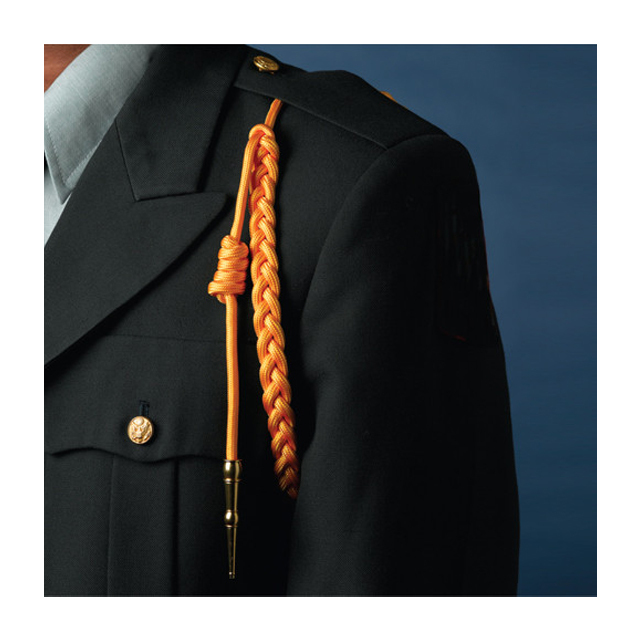 Single Strand Citation Cords: One Color
So even here, cords are not universal.
What Are Shoulder Cords For?
They serve three completely different purposes depending on context:
1. Branch Identification (Real Military)
Used only to show occupational branch.
Example:
Infantry = blue cord
Nothing else exists at Army level.
2. Achievement Recognition (JROTC)
Used like academic or athletic awards.
They indicate participation and commitment:
- competition teams
- academic excellence
- specialized training
Not rank. Not authority.
3. Functional Role (Ceremonial Units)
Some honor guards use cords so leaders can be identified instantly during events.
This is practical, not symbolic.
All Army Shoulder Cords, The Accurate Answer
If we are speaking about the actual U.S. Army:
There is exactly one authorized shoulder cord.
If we are speaking about Army JROTC:
There are multiple cords, but they represent activities, not career fields.
If we are speaking about online surplus stores:
They often sell decorative cords modeled after European traditions, not official U.S. uniform policy.
Army Cords Meaning, The Simple Truth
People assume cords are like medals.
They aren’t.
They work more like:
- a jersey number
- a team badge
- or a job title
The infantry cord doesn’t mean:
- bravery
- combat experience
- elite status
It simply means:
This soldier belongs to the Infantry branch.
That’s it.
No hidden lore.
Why the Confusion Persists
Three reasons:
- ROTC cadets graduate and keep assumptions
- Civilian ceremonial units use theatrical traditions
- Online uniform retailers generalize foreign systems
European armies historically used many decorative aiguillettes, the U.S. military never adopted that system broadly.
America standardized instead of ornamented.
A Quick Way To Identify Authentic Information
Ask one question:“Is this from official uniform regulation?”
If not, treat it as a ceremonial or local tradition.
The military is boringly consistent about uniforms.
If a color mattered, it would be written in regulation.
Common Myths (Debunked)
Myth: Every branch has its own cord
Reality: Only Infantry in the Army does
Myth: Yellow cord = elite
Reality: No official Army yellow cord exists
Myth: Cords show rank
Reality: Rank is displayed on insignia, never cords
Myth: Cords show deployments
Reality: Awards and ribbons do that
 Shoulder Cords with Pins: Two Colors
Why This Matters
Uniform items are not fashion.
They communicate structure instantly, especially in environments where mistakes matter.
Misidentifying them isn’t just trivia wrong.
It breaks the entire purpose of standardized visual hierarchy.
The military designs uniforms to be understood at a glance, even in chaos.
Final Word: Stop Guessing, Start Understanding
Military uniforms are built on precision. The colors of the military shoulder cords are part of that precision.
Whether you’re researching for uniform compliance, academic study, cadet programs, or ceremonial use, clarity matters.
Instead of assuming what a cord represents, look at context, branch regulations, and program guidance.
Because in military tradition, details aren’t small.
They’re the standard.
FAQs
1. What does a white shoulder cord represent?
A white shoulder cord commonly represents honor guard or ceremonial unit membership. In many JROTC and ROTC programs, it identifies color guard participants. While frequently associated with formal duties, exact meaning depends on branch regulations or school-level policy.
2. How do JROTC cords' meanings differ from active-duty military cords?
JROTC cords' meaning often varies by school or battalion within national program guidelines. Unlike active-duty military shoulder cords, which follow strict branch regulations, JROTC units may assign cord colors to recognize leadership, academics, drill team, or special achievements.
3. Are military shoulder cords earned or issued automatically?
Most military shoulder cords are earned distinctions tied to branch qualification, ceremonial duty, or leadership roles. In JROTC programs, cords are typically awarded based on merit, performance, or participation. They are not simply decorative accessories and carry formal recognition value.