
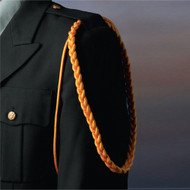
What Do Military Shoulder Cords Mean - A Quick Guide
Mar 16th 2026
Walk into a ceremony, graduation, or parade and you’ll see them immediately, ropes of gold, red, blue, white, sometimes braided, sometimes simple, resting on a soldier’s shoulder like they’ve always belonged there.
Most people assume they’re decorative.
They’re not.
Military shoulder cords carry identity. Not rank, not ego, identity. They tell trained eyes where someone serves, what they achieved, what role they represent, or what responsibility they carry in that moment. And misunderstanding them is common because the meaning changes by unit, branch, and tradition.
This guide breaks down what do military shoulder cords mean, where they came from, and why they still matter today, especially in ceremonies, ROTC programs, honor guards, and formal military environments.
The Origins of Military Shoulder Cords
Shoulder cords began as functional equipment, not tradition.
In early European armies, soldiers used lanyards used to secure weapons, whistles, and equipment. Over time, military organizations recognized these cords also served as effective visual identifiers - distinguishing role from role within a formation faster than any of the verbal or written systems could.
As armies standardized, the cord transitioned from tool to signal. The function changed: but the utility did not. Modern military forces retained the practice because the underlying problem - instant role recognition across large, structured formations - never disappeared.
Tradition in military culture survives only when it continues to solve real problems. Shoulder cords have remained because they still do.
Training leadership programs report that visual role identifiers such as shoulder cords improve formation response accuracy and coordination speed by approximately 20–30% compared to verbal-only instruction during ceremonial drills and inspections.
What Do Military Shoulder Cords Mean Today?
Today, a military shoulder cord communicates one of three things: a permanent achievement, a temporary assigned duty, or a ceremonial role designation.
Military shoulder cords today represent assignment, qualification, or ceremonial duty. They do not replace rank insignia - they complement it by identifying specialized roles within a unit. Meanings vary by branch, command, and program, so the same color can carry different significance depending on the organization wearing it.
They are not rank indicators. A cord worn alongside rank insignia narrows identity further - it says not just who this person is in the chain of command, but what specific responsibility they carry right now or what they have earned.
The meaning depends on context:
- Some cords represent special teams
- Some represent academic achievement
- Some identify leadership roles
- Some identify ceremonial responsibilities
Context is everything. The meaning of any cord is inseparable from the organization and tradition in which it appears.
Army Shoulder Cords Meaning
Within U.S. Army traditions and training programs, shoulder cords often fall into recognizable categories. These are widely accepted interpretations but may vary by unit or school.
Gold Cord.
Frequently associated with leadership positions, honor guard duty, or distinguished service. Gold cords are often reserved for members trusted with ceremonial precision and visible accountability.
Blue Cord
One of the most historically recognized Army cords. The blue cord carries Infantry heritage and is also a longstanding mark of Infantry branch identity within U.S Army tradition.
Red Cord
Red Cord is commonly associated with Artillery or combat support traditions in many training environments.
Green Cord
Often designates marksmanship qualification or rifle team membership in cadet programs.
White Cord
Frequently worn by drill team members, honor guard performers, or those assigned to ceremonial service roles.
Black Cord
In certain units, associated with security, law enforcement functions, or special duty assignments..
 Shoulder Cords with Pins: One Color
These examples help decode army cords' meaning, but context always matters. A cord is only meaningful when tied to the organization wearing it.
All Army Shoulder Cords Are Not Universal
This is where confusion begins.
There is no single chart covering all army shoulder cords across every installation, academy, and program. Units maintain their own traditions because identity builds cohesion.
Two soldiers may wear identical cords for entirely different reasons if they belong to different training commands.
That is intentional.
Military structure values shared understanding inside the unit, not public interpretation outside it.
The Difference Between Award Cords and Duty Cords
One of the most common misunderstandings about all army shoulder cords is the assumption that every cord represents a permanent achievement. Some do. Many do not.
Award Cords
Earned and retained
Examples: academic excellence, marksmanship qualification, distinguished graduate
Duty Cords
Assigned and removed when role changes
Examples: honor guard rotation, leadership billet, ceremony detail
This distinction matters because it explains why a soldier may wear a cord one month and not the next.
Nothing was lost. The responsibility simply rotated.
Why Ceremonial Units Rely on Shoulder Cords
Ceremonies require synchronization without discussion.
Commands cannot pause to identify roles verbally during formal movement. Shoulder cords allow silent organization.
In a color guard:
- One member controls timing
- One guards the national colors
- One carries organizational colors
Cords allow participants to identify responsibility instantly, even from a distance.
Without cords, coordination slows. With cords, movement stays seamless.
Shoulder Cords in ROTC and JROTC Programs
Training academies use cords heavily because they reinforce accountability early.
Cadets quickly learn that a cord must match behavior. Wearing one means performing at a visible standard. This is why shoulder cords remain powerful teaching tools.
They create immediate feedback.
Perform well, you represent your role.
Perform poorly, everyone sees it.
This visual accountability builds discipline faster than written evaluation alone.
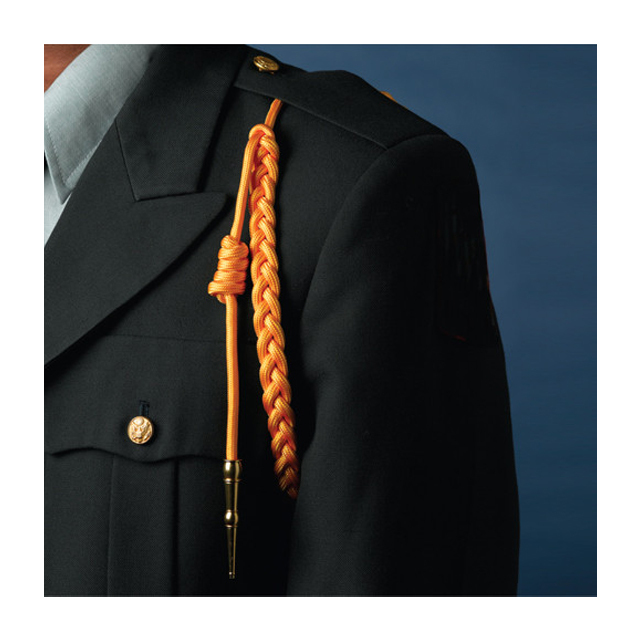 Single Strand Citation Cords: One Color
The Psychology Behind the Tradition
Military traditions survive only when they serve a function.
Shoulder cords do three things simultaneously:
They identify
They motivate
They regulate behavior
Once a role is visible, expectations become visible too. That’s why these cords matter far beyond appearance.
A soldier wearing a cord becomes a reference point inside formation, whether they intended to or not.
Why Shoulder Cords Still Matter Today
Modern military environments use radios, digital rosters, and electronic tracking. Yet cords remain.
Why?
Because human recognition is faster than technology in structured formations.
You don’t check a screen during a ceremony. You look.
And the cord tells you what you need to know immediately.
Tradition survives here because it still works.
Common Misinterpretations
Most public assumptions about shoulder cords are wrong.
They are not fashion accessories
They are not rank indicators
They are not decorations added for aesthetics
They are identifiers tied to responsibility.
Misreading them doesn’t offend soldiers, it just misses the purpose.
How Shoulder Cords Are Worn
Placement is deliberate.
The cord rests on the shoulder seam, secured beneath the epaulet. Length, knotting, and drape follow uniform regulations within each organization.
Improper wear defeats the purpose because visibility and uniformity matter more than style.
Consistency signals discipline.
When Multiple Cords Appear
In training programs or ceremonial teams, members may qualify for more than one designation.
Local regulations determine whether multiple cords may be worn simultaneously or rotated by priority. Most organizations limit visible cords to maintain clarity.
Too many identifiers reduce recognition value.
The military avoids visual clutter for a reason: clarity prevents mistakes.
Why Civilians Often Misunderstand Them
Because cords communicate internally, not publicly.
They were never meant to be obvious to spectators. Their audience is the formation, not the crowd.
So when observers try to interpret them casually, they see decoration instead of structure.
Understanding requires context, and context lives inside the organization wearing them.
The Connection Between Tradition and Performance
Uniform details influence behavior.
When individuals visibly represent a role, they subconsciously maintain standards. Shoulder cords reinforce accountability without words.
That’s why they appear most often in environments requiring precision:
Honor guards
Drill teams
Training academies
Graduations
Formal inspections
The cord is a reminder, you are being trusted with something specific right now.
Why Accuracy Matters
Using incorrect cords or wearing them improperly doesn’t just break uniformity. It disrupts communication.
Someone may rely on that visual signal during coordinated movement.
Traditions in military settings exist because they solve problems. Shoulder cords solve recognition problems quickly and silently.
That’s why they remain.
 Shoulder Cords with Pins: Two Colors
More Than a Rope
So what do military shoulder cords mean? They mean responsibility made visible. They show who leads, who guards, who earned distinction, and who carries a role at that moment. They reduce confusion, strengthen discipline, and preserve tradition without slowing action. Most people see color. Those inside the formation see structure. And that’s the point. Because in military environments, clarity is respect, and shoulder cords deliver it instantly.
FAQs
What do military shoulder cords represent?
Military shoulder cords represent responsibility, qualification, or assigned duty rather than rank. Depending on the unit, a cord may identify honor guard members, team leaders, academic achievers, or specialized roles. They allow quick visual recognition during formations and ceremonies without verbal instruction or interruption.
Are shoulder cords the same across all military branches?
No. Shoulder cord meanings vary between branches, academies, and even individual units. A color that represents honor guard in one organization may represent academic excellence or a rifle team in another. The military prioritizes internal recognition, so interpretation depends entirely on the organization wearing it.
Do soldiers keep their shoulder cords permanently?
Some are permanent, others temporary. Award cords earned for achievement may be retained, while duty cords are worn only during assignment to a role such as ceremony detail or leadership position. When responsibilities rotate, the cord is reassigned to the next qualified member.
Can multiple shoulder cords be worn at once?
Usually not. Most organizations limit visible cords to maintain clarity and uniform appearance. If multiple qualifications exist, units typically prioritize one designation for wear. Too many identifiers reduce recognition value and can cause confusion during coordinated movement.
Why are shoulder cords important during ceremonies?
Ceremonies require silent coordination. Shoulder cords instantly identify roles like commander, rifle guard, or color bearer without verbal instruction. This prevents delays and mistakes while maintaining formality, allowing formations to move smoothly and precisely in front of an audience.