
The Flag on the Casket Should Be American
Jun 25th 2026
There are a few things in this country that should never be up for debate. The flag is one of them.
Not the politics around it. The thing itself - the cloth, the stitching, the field of stars a young airman raises her right hand toward when she swears an oath she means with her whole life. That flag should be made here, by American hands, on American soil. It seems too obvious to need saying. And yet right now, it isn't the law. More than half the American flags flown in this country are made in China.
I run Glendale Parade Store, a 77-year-old company in San Antonio. We make flags for JROTC programs, military honor guards, federal agencies, and law enforcement. I'm also a major in the Air Force Reserve. So when I talk about this, I'm not talking about an abstraction. I've held these flags. I know what a correct one is supposed to feel like, and I know what's wrong with the cheap ones flooding in.
Start with the part that isn't about money
Most arguments for this start with economics, and we'll get there, because the numbers matter. But the heart of this is somewhere else.
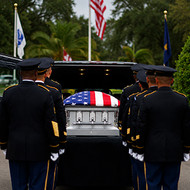
When a service member dies, the flag that drapes the casket is supposed to be the last honor we give them. When a police officer is killed in the line of duty, that folded flag handed to a spouse or a parent is the country saying we will not forget what this cost. That moment carries everything we are supposed to mean as a nation.
And the flags coming in from overseas are wrong. The dimensions are off. The proportions don't match the standard. The colors aren't right - the red drifts, the blue isn't the blue. A flag that's supposed to be exact, supposed to be the same every time because the standard is the point, instead becomes a sloppy approximation made by people who have no reason to care and every reason to cut a corner.
So picture it honestly. A flag folded into that tight triangle and pressed into the hands of a grieving family - and it's the wrong color, the wrong shape, churned out by a factory in a country our own military is preparing to deter. Picture a seventeen-year-old in a JROTC program, or a brand-new recruit, raising their hand to swear loyalty to a flag that was never really made for that oath at all.
That's the offense. Not the trade balance. The fact that we are willing to let the single most sacred object in American civic life be counterfeited, and we shrug.
How did we get here?
It wasn't an accident, and it wasn't fair competition.
China supplies 98% of all imported U.S. flags, and somewhere between 50 and 55 percent of every American flag consumed in this country. That's six to six and a half million flags a year - matching or exceeding our entire domestic production of about six million.
Here's the part people miss: 100% of the American flags China produces ship to the United States. No other country buys them. There is no global market for Chinese-made American flags. This is not a company in Shenzhen competing on a level field and winning. It's a deliberate, policy-driven effort to capture a specific market - ours - and to hollow out an industry that is, by its very nature, a matter of national identity.
The price tells the story. An American-made flag runs $30 to $48. The Chinese imports go for $8 to $20 - a three-to-four-times gap. That gap doesn't come from superior efficiency. It comes from state subsidies, government financing, and the simple fact that those factories carry none of the labor, safety, environmental, or compliance costs that any American manufacturer has to bear. The current 24.5% duty isn't close to enough to offset it.
The forced-labor problem nobody wants to look at
It gets darker. China's textile sector leans heavily on cotton, fiber, and yarn sourced from Xinjiang - a region with documented Uyghur forced labor. There is no credible way to trace flag-grade fabric, embroidery thread, or assembly coming out of China. A federal review found Chinese enforcement against forced-labor textile exports "extremely limited and largely ineffective."
Sit with what that means. The flag draped over the casket of an American service member may contain forced-labor inputs from the very regime that service member trained to stand against. We are, without meaning to, dishonoring our own dead with the products of someone else's oppression.
A loophole big enough to drive a truck through
You'd think federal law would at least keep this out of government buildings. It mostly doesn't.
The All-American Flag Act of 2024 was a real step - but it only applies to federal flag purchases above $250,000, the Simplified Acquisition Threshold. The overwhelming majority of federal flag buying happens below that line: the Post Office, VA hospitals, base exchanges, federal buildings, routine GSA orders. All of it sits in the gap.
And foreign-made flags keep slipping into federal procurement through e-commerce platforms like Amazon — frequently mislabeled, unlabeled, or marketed in ways that hide where they were actually made. This isn't paranoia: Customs and Border Protection lab testing shows a 50% discrepancy rate on textile imports. Half of them misrepresent what they actually are. A federal buyer clicking "purchase" has no realistic way to verify the truth.
So we have a situation where a flag made by forced labor, mislabeled as American, can be bought with taxpayer money and flown over a federal building. That should be impossible. Right now it's routine.
What the bill actually does
The Make American Flags in America Act - H.R. 1421 in the House, S. 900 in the Senate - is about as clean as legislation gets.
It requires every federal purchase of a U.S. flag to be made in America, regardless of dollar value. It closes the threshold loophole completely. It governs only federal procurement - there is no mandate on private citizens or private businesses, who can buy whatever they choose. And it directs the Federal Trade Commission to study and report on country-of-origin labeling for flags, a first real step toward cracking down on deceptive "Made in USA" marketing.
No fiscal cost. No private-sector mandate. And it's genuinely bipartisan: the House bill is led by Rep. Nick Langworthy, a New York Republican, and Rep. Greg Landsman, an Ohio Democrat. The Senate companion is led by Sen. Ted Cruz of Texas and Sen. Tammy Baldwin of Wisconsin. Republicans and Democrats, House and Senate. This is not a partisan fight. It's one of the few things left that genuinely shouldn't be.
What's at stake if we don't
The American flag industry supports more than 5,000 workers across a fully integrated supply chain - yarn, weaving, dyeing, embroidery, cut-and-sew, all of it here. In Texas alone, the textile sector employs more than 7,000 people, fifth in the nation.
But here's the thing about that kind of manufacturing capacity: once it's gone, it does not come back. You cannot rebuild a vertically integrated supply chain on demand. If we let it die, then one day the only American flags available - even the one on the casket, even the one over the Capitol — will be made somewhere else, by someone with no stake in what it means.
So why isn't this already law?
That's the question I keep coming back to. This costs nothing. It mandates nothing for private citizens. It has Republicans and Democrats behind it. It protects American workers and it protects the dignity of the single most important symbol we have.
How is it possible that Congress can't pass a law this simple - that when the federal government buys an American flag, that flag has to be made in America?
There's no good answer. So the only thing left to do is ask, plainly, for the thing to get done. If your representative hasn't co-sponsored H.R. 1421, ask them why. Ask them to fix it.
The flag we hand to a grieving family should be ours. All the way through. Made here, by us, for them. Anything less is a quiet little lie we tell at the worst possible moment — and we are better than that.