
Understanding US Space Force Flag: History, Meaning & Symbolism
Dec 8th 2025
There are flags, and then there’s the US Space Force flag, the newest banner in America’s military lineage and the first new service branch flag since 1947. While some people still pretend Space Force is “just a Netflix show,” the reality is simple: the world has already entered a new defense era, and the flag reflects that shift with serious intention, precision, and symbolism.
This isn’t a trendy design experiment or a pop-culture gimmick. The US Space Force flag represents national security in the most advanced warfighting domain humanity has ever touched, space.
Let’s unravel the history, symbolism, meaning, and standards behind this historic flag.
A Quick Historical Flashback: The Birth of the Space Force Flag
The US Space Force flag was officially unveiled on May 15, 2020, during a White House ceremony. It’s now the second branch under the Department of the Air Force, just as the Marine Corps is under the Department of the Navy.
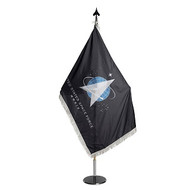
 US Space Force (US Govt Agencies) Flags
This wasn’t created “just because space sounds cool.” It was created because satellites, GPS networks, military communications, missile tracking, and orbital defense are now real targets and real battlegrounds. Space isn’t a sci-fi playground anymore. It’s a battlefield, and the flag declares U.S. presence there.
Why the flag matters historically:
- Signals the addition of the sixth U.S. military branch
- Establishes the identity and heritage of space warfighters
- Honors those who defend the nation beyond Earth’s atmosphere
Tradition matters, even when the battlefield is 100,000 miles up.
Design Breakdown: Every Element of the US Space Force Flag Has Meaning
A military flag doesn’t survive on aesthetics alone. Every detail carries strategy, legacy, and symbolism, and the US Space Force flag is no exception. As of early 2023, the Space Force is the sixth branch of the United States Armed Forces, the first new branch created in over 70 years.
Let’s decode it:
Black Background
No, it’s not meant to look edgy. The black field represents the vastness and depth of outer space, the new frontier of defense.
Delta Symbol
The large silver delta at the center dates back to 1959, rooted in the earliest Air Force space initiatives. It represents:
- Innovation
- Technical excellence
- Strength and warfighter heritage
This isn’t some “college fraternity triangle.” It’s a legacy emblem older than most critics.
Silver Outer Border & Inner Delta
These signify space defense layers, satellite architecture, orbital units, and missile warning systems that protect the nation around the clock.
Globe
Symbolizes Earth as the protected homeland, reminding us that the mission begins here.
Elliptical Orbit
Represents the constant vigilance of Space Force guardians, circling the Earth.
Polaris (North Star)
Polaris marks the guiding light, pointing to:
- Core values
- Strategic direction
- Always-ready integrity
In short, everything on the US Space Force flag has a job, just like the branch it represents.
Symbolism That Sets Space Force Apart
Sure, every military flag carries honor. But the US Space Force flag introduces a unique philosophy that no branch before it ever needed to express.
1. Warfighting Beyond Physical Boundaries
Unlike traditional domains (land, sea, air), space warfighting involves:
- Satellites
- Signal intelligence
- Orbital threat detection
- Missile tracking systems
The flag symbolizes defense without borders.
2. A Future-Focused Identity
Most branches celebrate history. The Space Force celebrates history and future simultaneously, protecting what humanity hasn’t even built yet.
3. Guardianship, Not Domination
The Space Force role isn’t sci-fi conquest. It’s protecting:
- National communications
- Navigation systems
- Global military coordination
- Civilian infrastructure reliant on satellites
The nation is more space-dependent than people realize. Without space defense, the world goes blind.
Protocol and Proper Display Rules
If you think you can hang the US Space Force flag wherever, like it’s a college dorm decoration, let’s pump the brakes.
Order of Display
In official military order, it sits:
- U.S. Flag
- Army
- Marine Corps
- Navy
- Air Force
- Space Force
- Coast Guard (unless part of the Navy during wartime)
Indoor Display
When displayed on a guidon pole set indoors, the US Space Force flag:
- Must not touch the ground
- Must be positioned according to the prescribed service order
- Must use official spearhead or chrome ornaments based on ceremony type
Outdoor Display
- Should be flown beneath the U.S. flag when sharing the same pole
- Should not fly in place of the U.S. flag
- Must use appropriate all-weather material and reinforced grommets in outdoor setups
Respect isn’t optional.
The US Space Force Flag’s Role in Ceremonies
This flag is not a random décor piece for military events. Its presence signifies:
- Activation of Space Force units
- Graduation of guardians
- Promotions and retirement honors
- Joint base ceremonies
- Memorial services when required
And yes, there are official guidon pole finials and bases designated for Space Force displays, because heritage cannot be improvised.
Who Buys the US Space Force Flag Today?
Short answer? More people than you think.
Primary buyers
- Active-duty Space Force units
- Retired guardians
- Military families
- Federal buildings and installations
Growing buyers
- Veteran associations
- ROTC programs
- Patriotic collectors
- Historical museums
Space Force isn’t a “maybe” thing. It’s now part of the U.S. military structure permanently, and institutions have started recognizing that. Well, there are no restrictions for any individual to buy it because this flag can be bought by every American, proudly!
Why the US Space Force Flag Matters More Than People Realize
Let’s be honest: a lot of people didn’t take the Space Force seriously in 2020. New things always get mocked. It happened to the Air Force in 1947 too.
Today?
- Nations are building orbital weapons
- Satellites are the backbone of global intelligence
- GPS is critical to everything from banking to aviation
- Space assets are becoming military targets
The US Space Force flag represents the guardians who stop chaos before the world even knows it was threatened.
Kind of badass, actually.
Final Takeaway
The US Space Force flag isn’t just another piece of fabric. It’s the mark of America’s evolution from terrestrial defense to extraterrestrial vigilance. It honors tradition while preparing for a battlefield most people will never see, and that’s exactly why it matters.
It represents:
- Protection of the homeland from above
- Modern innovation rooted in military heritage
- The next generation of American warfighters
Space is no longer the future; it’s the present, and the flag proves it.
FAQs
Does the U.S. Space Force have a flag?
Yes. The U.S. Space Force has an official flag, unveiled on May 15, 2020. It represents the newest branch of the U.S. Armed Forces and carries symbols reflecting the mission of protecting the nation’s interests in space. It’s used in military ceremonies, bases, and official government installations.
Is the Space Force part of the U.S. military?
Yes. The U.S. Space Force is the sixth branch of the U.S. Armed Forces. It operates under the Department of the Air Force, similar to how the Marine Corps operates under the Department of the Navy. Space Force personnel—called Guardians—conduct space operations to support national defense.
Why does the Space Force wear their flag on the left?
The U.S. flag is worn on the left shoulder so it faces forward rather than appearing reversed, symbolizing always advancing—not retreating. For the Space Force, the placement follows the same Department of Defense uniform regulations as other branches. It reflects forward motion, military tradition, and unity in combat identity.
Does the U.S. have a space flag?
Yes. The U.S. Space Force flag is the United States’ official space-service military flag. It represents operations in the space domain and is recognized alongside the flags of the Army, Marine Corps, Navy, Air Force, and Coast Guard. It symbolizes national presence and defense beyond Earth’s atmosphere.