 Shop Military & Cadets
 Shop First responders
The History of the 1903 Springfield: From WWI Battle Rifle to Ceremonial Icon
Jul 24th 2026
The 1903 Springfield rifle history continues to interest military historians, collectors, reenactors, and ceremonial organizations alike. Many people recognize the rifle by name but are less familiar with why it became one of America's most respected military firearms or how it remained relevant long after newer service rifles entered the battlefield.
Understanding the rifle's development, combat service, and lasting legacy provides valuable context for anyone researching U.S. military history or selecting a historically accurate ceremonial rifle.
This article explores why the Springfield was developed, the engineering that set it apart, its role in two World Wars, and how it evolved from a frontline battle rifle into a ceremonial icon still honored today.
Why the 1903 Springfield Was Developed
The origins of the Springfield 1903 rifle can be traced to the lessons learned during the Spanish-American War in 1898. At the time, U.S. troops primarily carried the Krag-Jørgensen rifle, a dependable bolt-action firearm chambered in .30-40 Krag.
Although reliable, it quickly became apparent that it lagged behind the Spanish Army's Mauser Model 1893 rifles in several important areas.
Spanish forces benefited from a rifle capable of faster loading, stronger bolt construction, and higher-velocity ammunition. American military leaders recognized that future conflicts would require a more modern infantry weapon capable of greater battlefield effectiveness.
Following the war, the U.S. Army evaluated several rifle designs before deciding to create an entirely new service rifle at Springfield Armory.
Officially adopted in 1903, the M1903 Springfield combined proven engineering concepts with American manufacturing standards, producing a firearm known for exceptional accuracy, durability, and reliability.
According to the Civilian Marksmanship Program, the rifle remained one of the most respected military bolt-action rifles ever issued by the United States.
How Mauser Design Influenced the 1903 Springfield
The M1903 Springfield incorporated several proven features from the German Mauser Model 1898, including a stronger bolt, controlled-round feeding, and stripper-clip loading. These improvements increased reliability and allowed faster reloading in combat.
Because the design used patented Mauser features, the U.S. government paid royalties to Mauser before entering World War I. Springfield Armory refined the rifle to meet American military requirements, creating a firearm known for its strength and precision.
Technical Features of the 1903 Springfield
The Springfield 1903 rifle featured a bolt-action mechanism with a five-round internal magazine loaded by stripper clips. Initially chambered for the .30-03 cartridge, it was soon updated to fire the .30-06 Springfield, which offered improved range and ballistic performance.
The rifle became known for its excellent accuracy, adjustable sights, and dependable operation under demanding field conditions. These qualities made it a trusted infantry rifle and later an effective platform for military marksmanship and sniper applications.
The 1903 Springfield in World War I
When the United States entered World War I in 1917, the Springfield 1903 rifle served as the nation's standard infantry rifle. American Expeditionary Forces carried it into Europe, where it quickly earned praise for its reliability and long-range accuracy under difficult combat conditions.
Trench warfare demanded firearms capable of functioning despite mud, rain, and constant exposure to dirt. The Springfield's robust bolt-action system proved dependable throughout these harsh environments.
Its accuracy also allowed trained riflemen to engage enemy positions at distances where precision could influence the outcome of an engagement.
Because production could not keep pace with the rapid expansion of the U.S. Army, many soldiers also received the M1917 Enfield rifle. Even so, experienced troops often preferred the Springfield because of its refined sights, excellent balance, and familiar handling characteristics.
The rifle also became an effective sniper platform during World War I. Selected rifles fitted with telescopic sights gave specially trained marksmen greater capability for precision fire against distant targets, observation posts, and machine-gun positions. This role demonstrated the platform's versatility and laid the groundwork for future sniper variants.
By the end of the war, the M1903 Springfield had established itself as one of America's most respected military rifles, earning a reputation that continued well beyond its years as the standard service weapon.
Changes and Variants That Extended the Rifle's Service Life
As military requirements changed, the U.S. Army introduced updated Springfield variants that improved handling, simplified production, and supported specialized combat roles. These changes allowed the rifle to remain in service for decades.
M1903A1, M1903A3, and M1903A4 Variants
The M1903A1 introduced one of the rifle's most recognizable improvements: a pistol-grip stock. While mechanically similar to the original model, the revised stock offered a more comfortable and secure grip, particularly during sustained marksmanship training and precision shooting.
The M1903A3 was designed primarily to simplify wartime production during World War II. Manufacturers adopted stamped metal components and redesigned aperture sights that were faster to produce without sacrificing reliability. These manufacturing changes enabled higher production rates while maintaining battlefield effectiveness.
The M1903A4 represented the rifle's dedicated sniper configuration. Built without standard iron sights, it was equipped to accept telescopic optics for precision engagements at extended distances. Its exceptional accuracy made it one of the U.S. military's principal sniper rifles during World War II.
Although each variant served a different purpose, they all retained the Springfield's defining qualities: dependable operation, excellent craftsmanship, and remarkable accuracy. Those characteristics explain why the rifle continued serving long after many of its contemporaries had disappeared from military inventories.
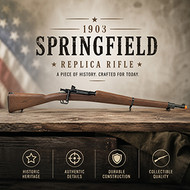
For ceremonial organizations seeking historically inspired equipment today, modern Drill America 1903 Springfield replica rifles preserve the appearance and balance of the original service rifle while being purpose-built for drill, honor guard, and parade use rather than for live firing. They continue the visual legacy of one of America's most recognizable military rifles.
The 1903 Springfield During World War II and Later Conflicts
Although the M1 Garand became the U.S. Army's standard service rifle in 1936, the Springfield 1903 rifle remained in active use during World War II. Producing enough Garands for a rapidly expanding military took time, so many Army units, Marines, and training commands continued carrying the M1903 during the early years of the war.
The rifle also filled specialized roles that the M1 Garand could not. The M1903A4 sniper variant, equipped with a telescopic sight, became one of the U.S. military's primary sniper rifles. Its bolt-action design and excellent accuracy made it effective for long-range precision shooting throughout World War II.
After the war, the Springfield continued serving in limited numbers during the Korean War and the early stages of the Vietnam War, mainly in sniper and training roles. Its long service life reflected the quality of its design and the confidence generations of service members placed in the rifle.
How the 1903 Springfield Became a Ceremonial Rifle
When the Springfield's combat service came to an end, it found a lasting place in military ceremonies. Today, Springfield-style rifles remain closely associated with honor guards, veterans' organizations, military academies, ROTC and JROTC programs, and ceremonial drill teams.
The rifle's historical significance and distinctive appearance make it a fitting choice for military funerals, memorial services, parades, and color guard presentations. These ceremonies honor those who served while preserving traditions that have been passed from one generation to the next.
Most organizations now use purpose-built ceremonial replicas rather than original military-issued rifles. A Drill America 1903 Springfield replica rifle closely matches the look and balance of the original while being designed specifically for parade, drill, and honor guard use.
To maintain a professional appearance, many ceremonial units also use quality rifle slings, protective rifle cases, and other rifle accessories. These items help protect equipment during transport and ensure rifles remain in excellent condition for repeated ceremonial use.
The 1903 Springfield's Legacy Among Collectors and Historians
More than a century after its adoption, the history of the 1903 Springfield rifle continues to attract collectors and military historians. Original rifles are valued for their craftsmanship, wartime service, and connection to major events in American military history.
Collectors often look for factors such as manufacturer, production year, originality, and overall condition. Rifles produced by Springfield Armory and Rock Island Arsenal are especially sought after, while documented military-issued examples carry additional historical value.
Museums across the United States display the M1903 in exhibits on World War I, World War II, and the evolution of American military firearms. Historians also recognize the rifle for influencing later military weapon designs through its emphasis on accuracy, durability, and dependable performance.
For ceremonial organizations and historical programs, modern replicas offer a practical way to preserve this legacy. They provide the appearance and handling of the original rifle without exposing valuable historical firearms to everyday use.
Organizations purchasing ceremonial rifles should also complete the appropriate rifle registration to maintain accurate ownership records and manufacturer support.
Conclusion
The 1903 Springfield rifle history is a story of innovation, military service, and lasting tradition. Developed after the Spanish-American War, the rifle became the standard U.S. infantry weapon during World War I, continued serving through World War II and later conflicts, and eventually earned a respected role in military ceremonies.
Its reputation for accuracy, reliability, and craftsmanship has made it one of the most recognized rifles in American military history. Today, honor guards, drill teams, veterans' organizations, and military academies continue to preserve that heritage through ceremonial use.
If you're looking for a historically accurate ceremonial rifle, explore Glendale Parade Store's collection of replica rifles, including the Drill America 1903 Springfield Replica Rifle. You'll also find compatible rifle slings, rifle accessories, and protective rifle cases designed to support professional honor guards, color guards, and ceremonial units.
Frequently Asked Questions
When did the 1903 Springfield replace the Krag-Jørgensen rifle?
The M1903 Springfield officially replaced the Krag-Jørgensen on June 19, 1903, after the U.S. Army sought a stronger, faster-loading rifle following lessons learned during the Spanish-American War.
Why was the 1903 Springfield replaced by the M1 Garand?
The M1 Garand's semi-automatic action allowed soldiers to fire faster without manually cycling the bolt after every shot, giving U.S. troops greater firepower while maintaining effective accuracy.
What is the difference between the M1903, M1903A3, and M1903A4?
The original M1903 served as the standard infantry rifle. The M1903A3 introduced manufacturing improvements and an aperture rear sight, while the M1903A4 was built as a sniper rifle equipped for telescopic optics.
Why is the 1903 Springfield still used in ceremonial duties?
Modern ceremonial versions preserve the rifle's historic appearance and military significance. They are commonly used by honor guards, veterans' organizations, military academies, and drill teams during funerals, memorials, and parades.
Is the 1903 Springfield considered a collectible rifle?
Yes. Original M1903 rifles are highly collectible because of their military history, limited production variations, and service in both World Wars. Factors such as originality, condition, and manufacturer greatly influence their value.