 Shop Military & Cadets
 Shop First responders
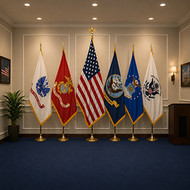
How to Display Multiple Flags in One Room Without Breaking Protocol
Jul 10th 2026
Many organizations, schools, military units, veterans groups, and public institutions need to display multiple flags indoors but are often unsure how to do so correctly, especially when several flags share the same room.
Understanding how to display multiple flags properly helps ensure respect for national symbols while staying compliant with flag etiquette, whether you're arranging a government office, JROTC classroom, veterans hall, or corporate lobby. This guide covers Flag Code fundamentals, order of precedence, military branch arrangements, row and V-shaped configurations, and setup by setting type.
Why Indoor Flag Display Protocol Still Matters
Indoor flag displays serve a ceremonial purpose beyond decoration. In government facilities, schools, and military installations, flag arrangements communicate respect for national authority, military service, and organizational heritage.
Portions of the Flag Code are advisory rather than legally enforceable for civilians, but they remain the widely accepted standard for flag presentation nationwide.
U.S. Flag Code Basics: What You Need to Know Before Displaying Multiple Flags
Before deciding how to display multiple flags indoors, it helps to know a few foundational principles from the U.S. Flag Code. The flag's position of honor depends on how the flags are arranged:
- Separate staffs in a straight row (matching flagpoles or floor stands along a wall or stage): the U.S. flag goes at the observer's left, with remaining flags to its right in descending order of precedence. All staffs should be the same height, since the U.S. flag should never sit lower than a flag beside it.
- Flags grouped on a single staff, fan, or semicircle: the U.S. flag goes in the center and at the highest point, on a taller staff than the rest.
- Flags arranged in a V shape: a variation of the grouped configuration, following the same center-and-height rules, covered further below.
Know which configuration you're building first, since a row and a fan are not interchangeable.
Common Flag Code Violations to Avoid Indoors
- Placing another flag in the position of honor
- Displaying military branch flags before the U.S. flag
- Arranging state flags ahead of the national flag
- Placing the U.S. flag lower than an adjacent flag
- Crowding flags too closely together
- Displaying worn, damaged, or faded flags
The Order of Precedence for Displaying Multiple Flags Indoors
The American flag holds the highest position of precedence in any indoor display, staying the focal point in the position of honor appropriate to the configuration above, regardless of how many flags are present.
State and Territorial Flags
State flags follow the U.S. flag. The standard convention in most government, military, and ceremonial settings is order of admission to the Union (Delaware first, Hawaii last), with alphabetical order an accepted fallback when admission order isn't practical. Territorial flags (D.C., Puerto Rico, Guam, and others) follow the state flags.
Military Branch Flags and Their Correct Order
Military service flags are displayed in this order: Army, Marine Corps, Navy, Air Force, Space Force, and Coast Guard. This doesn't follow founding dates, or the Coast Guard (established 1790) would outrank the Air Force and Space Force. Instead, it reflects Department of Defense Directive 1005.8, with the Coast Guard's position tied to its peacetime operation under the Department of Homeland Security. Military branch flags never outrank the U.S. flag and typically follow national and state flags.
Note: In 2025, an executive order authorized "Department of War" as a secondary title for the Department of Defense. Both names refer to the same department; this guide uses "Department of Defense" for consistency with existing statute.
Organizational, Institutional, and Unit Flags
School, agency, corporate, and veterans organization flags, along with ROTC guidons, generally follow national, state, territorial, and military flags, though the exact arrangement may vary by tradition. These flags should never sit above the U.S. flag.
How to Display Multiple Flags in a Row
Many facilities use side-by-side floor stands or flagpoles to present several flags together. A natural focal point falls at center with an odd number of flags, but the U.S. flag still belongs at the observer's left in a straight row, not the center, unless a grouped or V-shaped setup is used instead. Protocol always outranks visual symmetry.
Each flag needs enough space to hang naturally without overlapping its neighbors, since crowded displays diminish visibility. All staff should be the same height, with matching indoor flag poles and flag stands creating a uniform look while order of precedence, not staff height, communicates hierarchy. Facilities that regularly move flags for ceremonies often rely on professional flag carriers to protect the flag and staff in transport.
V-Shaped (Fan) Flag Arrangements
A V-shaped or fan arrangement, with staffs angled outward from a central point behind a podium or stage, is a variation of the grouped display rather than a row, with its own placement and counting rules.
The U.S. flag occupies the apex, on the tallest staff, so it sits visibly above the rest. Remaining flags fan outward in descending order of precedence, alternating sides: the next-highest flag goes to the observer's left of center, the following flag to the right, and so on.
With an odd total number of flags, the U.S. flag sits alone at the apex with the rest dividing evenly on each side. With an even total, the U.S. flag still occupies the center alone, leaving an odd number of remaining flags that can't split evenly, so the extra one conventionally goes on the observer's left, closest to the center of honor.
Flag Display by Setting Type
The ideal arrangement for multiple flags depends on where they are displayed and the purpose they serve. While the U.S. flag always retains the position of honor, each setting may have additional protocol or practical considerations to ensure a respectful and professional presentation
Government Offices and Federal Buildings
Government facilities typically display the U.S. flag alongside state, territorial, agency, or departmental flags. Because these displays are often public-facing, following established flag protocol ensures consistency, professionalism, and respect.
Schools, Classrooms, and JROTC Rooms
Schools commonly display national, state, and organizational flags. JROTC programs may also include service branch flags, unit guidons, or ceremonial colors, often arranged in V or fan formations for assemblies and inspections. Proper placement reinforces civic and military traditions.
Churches, Chapels, and Religious Spaces
Many churches and chapels display both religious and national flags. When shown together, the American flag should always remain in the position of honor while respecting the traditions of the religious institution.
Corporate Offices and Public Lobbies
Businesses often display the U.S. flag alongside state, corporate, or international flags. Maintaining the correct flag order creates a professional appearance and helps avoid protocol mistakes that visitors may notice.
Military and Veterans Organization Halls
Veterans organizations, military museums, and service facilities often feature the most complex displays, including national, POW/MIA, military service, campaign, and organizational flags. These are commonly arranged in fan or V formations behind stages or memorials. Organizations with historical displays also preserve retired ceremonial flags in display cases and protective covers to honor their legacy for future generations.
Displaying the POW/MIA Flag Correctly
The POW/MIA flag holds a unique place in military and veterans communities. There's no single codified federal rule for where it ranks relative to state and organizational flags, but common best practice places it directly beneath the U.S. flag on a single staff, or immediately following it in a row or V-shaped display.
Armed Forces Flag Sets for Institutional Use
Many schools, military organizations, veterans groups, and government facilities use complete Armed Forces flag sets for consistent presentation. Matching dimensions, indoor poles, and ceremonial flag ornaments create a professional appearance while helping maintain proper order.
Conclusion
Knowing how to display multiple flags correctly helps organizations honor military traditions, comply with flag etiquette, and create professional indoor displays that reflect the significance of the flags presented.
Whether arranging a government office, school, veterans hall, or ceremonial space, in a straight row or a V-shaped fan, the principles stay consistent: place the U.S. flag in the position of honor appropriate to the configuration, follow established precedence rules, and maintain a clean, balanced presentation.
Glendale has supplied flags and ceremonial display products to military organizations, government agencies, schools, veterans groups, and civic institutions for decades. If you're setting up or updating an indoor display, browse Glendale's flag display solutions for quality poles, stands, and ceremonial accessories.