 Shop Military & Cadets
 Shop First responders
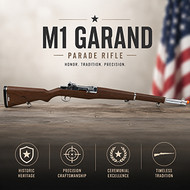
The History of the M1 Garand: From WWII Service Rifle to Parade Rifle
Jul 22nd 2026
Long before it became a familiar sight at military funerals, honor guard ceremonies, and JROTC competitions, the M1 Garand earned its place in history on the battlefield.
The M1 Garand rifle's history is not simply the story of a military firearm; it is the story of innovation, service, and a legacy that continues to shape American military tradition nearly a century after its adoption.
For today's cadets, ceremonial teams, veterans, and military history enthusiasts, understanding how the M1 Garand evolved from America's standard service rifle to one of its most respected parade rifles offers a deeper appreciation for the traditions it represents.
This article traces that journey, from its revolutionary beginnings to its enduring role in honoring those who served.
What Is the M1 Garand?
The M1 Garand rifle was the first semi-automatic rifle adopted as the standard service rifle by the U.S. Army. Officially entering service in 1936, it replaced the bolt-action M1903 Springfield and remained America's primary infantry rifle throughout World War II and the Korean War.
Why the M1 Garand Was Revolutionary
When the M1 Garand entered military service, most armies around the world still relied on bolt-action rifles that required soldiers to manually chamber each round after firing. The Garand changed that.
Its gas-operated, semi-automatic action allowed soldiers to fire eight rounds in quick succession without removing their hands from the firing position. While that may seem ordinary today, it gave American infantry a significant advantage in the late 1930s and throughout World War II.
General George S. Patton later described it as "the greatest battle implement ever devised," a quote the Smithsonian's National Museum of American History has documented as part of the rifle's official historical record. Although it reflected Patton's personal assessment rather than an official military designation, it captured the confidence many American soldiers placed in the rifle.
The Origins of the M1 Garand
The history of the M1 Garand rifle began during the years between the First and Second World Wars. Military leaders had seen the limitations of bolt-action rifles during World War I and wanted a weapon that could improve the firepower of the individual soldier without sacrificing accuracy or reliability.
That challenge was entrusted to John C. Garand, a Canadian-born engineer working at Springfield Armory in Massachusetts. Rather than designing a completely experimental firearm, Garand focused on creating a rifle that soldiers could depend on in demanding field conditions.
His design underwent years of testing, revisions, and competition against other prototypes before the U.S. Army officially adopted it in 1936.
Several features set the rifle apart from its predecessors:
- Semi-automatic operation for faster follow-up shots
- A gas-operated system that improved reliability
- An eight-round en bloc clip for efficient loading
- A durable combination of forged steel and hardwood built to withstand combat
These innovations established the M1 Garand as one of the most influential military rifles ever fielded by the United States.
The M1 Garand in World War II
The true test of the M1 Garand came only a few years after its adoption.
From the beaches of Normandy to the forests of Europe and the islands of the Pacific, the rifle became a constant companion for American infantry. It served in virtually every major U.S. campaign of World War II, earning a reputation for dependability under some of the harshest battlefield conditions imaginable.
While no single rifle determines the outcome of a war, the M1 Garand gave American soldiers a practical advantage over many opposing forces still armed primarily with bolt-action rifles. A soldier equipped with a Garand could maintain aimed fire more rapidly without interrupting their shooting position to cycle the bolt after every round.
That advantage proved especially valuable during close engagements, defensive actions, and rapidly changing combat situations.
Historical Fact: Approximately 4 million M1 Garand rifles were produced during World War II, helping equip U.S. forces across the European and Pacific theaters. According to production records kept by the Springfield Armory National Historic Site, total M1 Garand manufacturing exceeded 5.4 million rifles before production ended in 1957.
A Reputation Earned in Combat
The Garand's reputation wasn't built through advertising or legend, it was built through the experiences of the soldiers who carried it.
Its rugged construction helped it perform in mud, rain, snow, and tropical environments. Veterans consistently praised its balance of accuracy, durability, and reliability, qualities that contributed to its lasting place in American military history.
Did You Know?
One of the most enduring stories surrounding the M1 Garand is the famous "Garand ping." A popular myth suggests enemy soldiers waited for the metallic sound of the empty clip ejecting before attacking. Historians, however, have found little evidence that this was a common battlefield tactic, making it one of the rifle's most debated legends rather than a documented military practice.
The M1 Garand After World War II
Victory in 1945 did not end the Garand's military service.
The rifle continued to equip American forces during the Korean War, where its dependable performance once again earned the confidence of U.S. troops, particularly in difficult mountain terrain and freezing winter conditions.
By the late 1950s, advances in military tactics and firearms technology led to the adoption of the M14 rifle, which the Army Historical Foundation notes offered a detachable magazine and the newer 7.62×51mm NATO cartridge.
Although the M14 eventually replaced the Garand as the standard service rifle, the transition happened gradually, and many allied nations continued using the M1 Garand for years afterward.
Few military rifles remain relevant long after leaving frontline service. The M1 Garand was one of the exceptions. Rather than disappearing into history, it found a new purpose, one that preserved its connection to military service while honoring those who came before.
M1 Garand Specifications and Design Features
The M1 Garand was built for reliability, not lightweight portability. Measuring approximately 43.5 inches long and weighing about 9.5 pounds unloaded, it offered the balance and durability expected of a full-size infantry rifle.
Its most recognizable feature remains the eight-round en bloc clip, which automatically ejects after the final round is fired, producing the unmistakable metallic sound known as the "Garand ping." Combined with its walnut stock and forged steel receiver, the rifle developed a distinctive appearance that remains instantly recognizable today.
Ironically, the same characteristics that made the Garand a dependable combat rifle, such as its length, weight, and balanced construction, also made it exceptionally well suited for precision drill.
Those qualities would eventually inspire the modern M1 Garand dummy rifle, allowing a new generation of cadets and ceremonial units to preserve military traditions without using operational firearms.
How the M1 Garand Transitioned From Combat to Ceremonial Use
Most military equipment is eventually retired and replaced. The M1 Garand followed a different path. Although it left frontline combat service, it never left military tradition.
Its full-length wooden stock, balanced weight, and distinctive silhouette made it an excellent rifle for ceremonial drill. As veterans returned home and military customs continued, honor guards, color guards, and ceremonial units adopted the M1 Garand to represent the discipline and professionalism associated with those who carried it in service.
Today, the rifle remains a familiar sight at military funerals, memorial ceremonies, and patriotic events. Its presence is more than symbolic; it reflects generations of military service and honors those who wore the nation's uniform.
The M1 Garand as a Parade and Drill Rifle Today
Original service rifles are valuable historical firearms, making them impractical for routine drill instruction. Instead, many JROTC, ROTC, and honor guard programs use an M1 Garand dummy rifle designed specifically for ceremonial use.
Modern replicas closely match the size, balance, and appearance of the original while eliminating the need for a functioning firearm. This allows cadets and ceremonial teams to safely practice rifle manual, exhibition drill, and parade movements while preserving military tradition.
Weight is another important consideration. A quality drill rifle should closely replicate the original's handling characteristics, helping teams maintain consistency during inspections, competitions, and public ceremonies.
For teams seeking an authentic training experience, the DrillAmerica® M1 Garand Replica Rifle (9 lbs.) from Glendale Parade Store is built to closely replicate the original rifle's size, weight, and balance.
Designed for ceremonial use, it provides the realistic feel needed for precision drill practice while allowing cadets and honor guards to train safely and uphold the traditions of military ceremony with confidence.
Organizations looking for ceremonial equipment can explore Glendale's selection of Replica Rifles, along with compatible Rifle Slings and Rifle Accessories, to complete a professional drill setup.
M1 Garand Replica Rifles for Drill and Ceremonial Teams
Not every replica is built for the demands of a precision drill. A quality ceremonial rifle should offer durable construction, realistic balance, and reliable hardware that can withstand frequent training and public performances.
For JROTC units, ROTC programs, honor guards, and ceremonial organizations, selecting a purpose-built replica helps ensure consistent handling and long-term durability.
Protective Rifle Cases also help safeguard equipment during transportation and storage, while Glendale's Register Your Rifle program provides convenient product registration for eligible models.
The Cultural Legacy of the M1 Garand
Few military rifles have remained as recognizable decades after leaving combat service as the M1 Garand. It represents a generation of Americans who served during World War II and the Korean War, while continuing to play an important role in preserving military customs.
Whether carried by an honor guard at a veteran's funeral or used by cadets learning precision drill, the M1 Garand connects today's ceremonial traditions with the service and sacrifice of those who came before. That lasting connection is why it remains one of the most respected rifles in American military history.
Conclusion
The M1 Garand rifle history is a story of innovation, battlefield service, and enduring tradition. What began as a revolutionary infantry rifle became a lasting symbol of honor, discipline, and remembrance.
Today, while original rifles are treasured historical artifacts, high-quality replicas allow military organizations, schools, and ceremonial teams to continue those traditions safely and respectfully.
For those seeking equipment that reflects the appearance and balance of the historic rifle, Glendale offers a selection of Replica Rifles, including the DrillAmerica M1 Garand Replica Rifle, designed specifically for drill and ceremonial use.
Frequently Asked Questions
Is the M1 Garand an assault rifle?
No. The M1 Garand is a semi-automatic service rifle and does not meet the military definition of an assault rifle.
What caliber is the M1 Garand?
The original M1 Garand was chambered in .30-06 Springfield.
What rifle replaced the M1 Garand?
The U.S. Army officially replaced the M1 Garand with the M14 rifle beginning in 1957.
Can you still buy an M1 Garand?
Yes. Qualified U.S. citizens may purchase surplus rifles through the Civilian Marksmanship Program (CMP), while ceremonial organizations commonly use non-firing replica rifles for drill and parade activities.
Is the M1 Garand used in JROTC drill teams?
Yes. Many JROTC, ROTC, and honor guard programs use M1 Garand replica rifles because they closely resemble the original while providing a safer option for training and ceremonies.
How much does an M1 Garand replica rifle weigh?
The Glendale Parade Store M1 Garand replica rifle weighs 9 pounds, offering a realistic feel and balance for ceremonial use, drill practice, and parade performances while closely replicating the handling characteristics of the original M1 Garand.
What is the "Garand ping"?
The "Garand ping" is the distinctive metallic sound produced when an M1 Garand fires its final round. After the eighth cartridge is discharged, the rifle automatically ejects the empty en bloc clip, creating the ringing noise that has become one of the rifle's most recognizable characteristics.