 Shop Military & Cadets
 Shop First responders
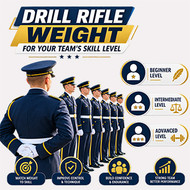
How to Choose the Right Drill Rifle Weight for Your Team's Skill Level
Aug 28th 2026
Choosing the right drill rifle weight can have a significant impact on how quickly cadets develop proper drill technique. Many instructors assume heavier rifles automatically produce better drillers, while others keep every cadet on the same rifle regardless of experience.
Both approaches can slow skill development and increase unnecessary fatigue. The best drill rifle weight is the one that matches a team's current skill level and training goals. As cadets gain strength, coordination, and confidence, they can gradually transition to heavier rifles when appropriate.
This guide explains how to match rifle weight to skill level, recognize when a team is ready to progress, and avoid common mistakes when building a successful drill program.
Why Rifle Weight Should Track Skill Level, Not Stay Fixed
A drill rifle is a training tool, not a test of strength. While weight influences how a rifle feels during manual movements and exhibition routines, proper technique should always come before handling a heavier rifle.
Cadets who begin with a rifle they can comfortably control are more likely to develop:
- Consistent rifle placement
- Proper grip and hand transitions
- Smooth facing and manual movements
- Better timing during synchronized drill
- Greater confidence during inspections and ceremonies
Starting too heavy often causes cadets to compensate with poor mechanics, making those habits harder to correct later. Military drill manuals establish the standards for drill movements, but they do not require every training unit to use the same rifle weight.
JROTC units, military academies, and drill teams often select training equipment based on their instructional objectives, cadet experience, and safety considerations rather than weight alone.
The Skill Progression: Beginner to Advanced Drillers
Beginner Cadets: Building Fundamentals First
New cadets benefit most from learning correct movement patterns before managing additional weight.
During the first stage of training, instructors should prioritize consistency over difficulty. A rifle that feels balanced and manageable allows cadets to focus on commands, posture, spacing, and weapon control instead of simply supporting the rifle.
At this level, training typically focuses on:
- Position of Attention
- Order Arms
- Present Arms
- Shoulder Arms
- Facing movements
- Basic marching sequences
If a cadet struggles to maintain muzzle control or repeatedly loses proper rifle alignment, the issue is usually technique, not a need for a heavier rifle. For units equipping new drillers, a lighter training rifle can make it easier to build proper fundamentals before progressing to heavier models.
For example, Glendale's DrillAmerica® MK1 Replica Rifle is designed as a lightweight training option for JROTC units, drill teams, and cadets beginning their drill instruction.
Intermediate Drillers: Developing Control and Consistency
Once cadets consistently perform regulation drill movements with good posture and control, they may be ready to transition to a slightly heavier rifle.
The goal is not simply increasing resistance. A heavier rifle helps prepare cadets for longer ceremonies, more complex manual movements, and improved control during continuous practice sessions.
Before increasing rifle weight, instructors should confirm that cadets can:
- Maintain proper posture throughout drill
- Execute manual movements consistently
- Keep time with the rest of the unit
- Complete extended practice sessions without losing control
- Handle the rifle safely during every transition.
Meeting these benchmarks is generally a better indicator of readiness than strength alone.
Advanced and Competitive Drillers: Exhibition-Ready Handling
Advanced drill teams often perform faster sequences, complex spins, aerial maneuvers, and extended exhibition routines. These movements require precise rifle control, endurance, and extensive repetition.
For experienced teams, instructors may select heavier replica rifles because the additional weight can provide greater stability during controlled movements. However, heavier equipment should only be introduced after cadets consistently demonstrate excellent technique and safe handling.
Competitive programs should also consider factors beyond weight, including:
- Balance and center of gravity
- Overall rifle length
- Grip consistency
- Training frequency
- Event requirements
- Cadet endurance
Rather than assuming the heaviest option is best, experienced instructors typically look for a rifle that offers predictable handling throughout long practice sessions.
For teams preparing to advance from entry-level training, comparing different replica rifle models, including options such as the M1 Garand Replica Rifle, can help instructors choose equipment that aligns with their training progression while maintaining consistency across the unit.
Signs Your Team Is Ready to Move Up in Rifle Weight
Increasing drill rifle weight should be based on performance, not time spent in the program.
Your team may be ready if cadets consistently:
- Maintain excellent rifle control throughout practice.
- Finish longer drill sessions without excessive fatigue.
- Perform regulation movements accurately under instructor evaluation.
- Recover quickly from minor mistakes.
- Demonstrate safe rifle handling at all times.
- Show consistent performance across the entire squad rather than only among the strongest cadets.
If these benchmarks are not yet consistent, additional practice with the current rifle weight is usually more beneficial than transitioning too early.
Common Mistakes When Matching Rifle Weight to Skill Level
Selecting the right drill rifle weight should support long-term skill development, not simply increase difficulty. Avoiding a few key mistakes can help prevent slow progress and frustration within a unit.
Assuming Heavier Always Means More Advanced
A heavier rifle does not automatically improve performance. Without solid fundamentals, it can lead to poor posture, inconsistent movements, and fatigue. Precision and technique should guide progression, not weight alone.
Moving Cadets Up Before They're Ready
Advancing too early can weaken confidence and reinforce bad habits. Cadets should only transition when they can consistently maintain control throughout practice, not based on a single strong performance.
Keeping an Entire Unit on Mismatched Weights
Cadets develop at different rates, so a single standard weight may not suit everyone. Many successful drill programs gradually introduce different rifle weights based on demonstrated ability while maintaining uniformity within individual squads or performance teams whenever possible.
How to Transition Your Team to a New Rifle Weight
A gradual transition produces better results than switching every cadet at once.
Consider introducing heavier rifles during selected practice periods rather than every training session. This allows cadets to adapt to the additional weight while maintaining confidence with the techniques they have already mastered.
During the transition, instructors should monitor:
- Rifle control during manual movements
- Cadet endurance throughout practice
- Consistency in timing and synchronization
- Grip and posture under fatigue
If performance noticeably declines, additional practice with the previous rifle weight may be more beneficial before progressing again.
Managing a Unit With Mixed Skill Levels and Rifle Weights
Many JROTC and drill units include first-year cadets alongside experienced exhibition performers. Using different rifle weights during training is often the most practical way to accommodate those differences.
Grouping cadets by experience allows instructors to tailor drills to each team's ability while helping newer members progress safely. As cadets improve, rifles can be reassigned based on performance instead of seniority.
This approach supports steady development without holding back advanced performers or overwhelming beginners.
Building a Rifle Fleet That Grows With Your Team
A well-planned rifle inventory allows instructors to support new cadets while preparing experienced drillers for higher-level performance.
Budgeting for Phased Purchases
Rather than replacing every rifle at once, many schools and organizations expand their inventory over time. Adding new models as training needs change helps distribute costs while ensuring every skill level has appropriate equipment available.
Reusing or Reassigning Rifles as Cadets Advance
When experienced cadets move to heavier rifles, lighter models remain valuable training tools for incoming members. This phased approach extends the service life of the unit's equipment and creates a structured progression for future cadets.
When to Introduce Exhibition-Specific Rifles
Exhibition-specific rifles should be introduced only after cadets consistently demonstrate excellent control during regulation drill.
Before making the transition, instructors should ensure cadets can safely perform advanced manual movements, maintain consistent timing under pressure, and understand proper rifle handling during practice and performances.
Introducing exhibition rifles too early often slows overall development because cadets spend more time compensating for equipment than refining technique.
Keeping a Uniform Look and Feel Across Skill Levels
Even when a unit trains with different rifle weights, maintaining a consistent appearance remains important for inspections, ceremonies, and public performances.
Whenever possible, choose replica rifles with similar dimensions, finishes, and handling characteristics. A consistent platform allows cadets to transition more smoothly as they progress while preserving a professional appearance across the unit.
Conclusion
Choosing the right drill rifle weight is about matching equipment to a cadet's current ability while creating a clear path for future development. Beginning with a manageable rifle allows cadets to build proper fundamentals, while gradual progression helps improve control, endurance, and confidence as skills advance.
Whether you're equipping a new JROTC unit or expanding an established drill team, selecting replica rifles that support every stage of training helps build a safer, more consistent, and more successful program.
Explore Glendale Parade Store's selection of high-quality replica rifles designed for drill teams, JROTC programs, honor guards, and ceremonial use to find the right equipment for every stage of your team's progression.
Frequently Asked Questions
How do I know when a cadet is ready for a heavier rifle?
A cadet is generally ready when they consistently demonstrate proper rifle control, accurate manual movements, safe handling, and can complete extended practice sessions without significant fatigue or loss of technique.
Should an entire unit train on the same rifle weight?
Not necessarily. Units with mixed experience levels often benefit from using different rifle weights during training. However, maintaining consistent equipment within squads or competition teams can help preserve synchronization and uniformity.
Can a lighter rifle still be used for regulation drill?
Yes. A lighter drill rifle is often the better choice for beginners because it allows cadets to develop correct fundamentals before progressing to heavier equipment. Proper technique is more important than rifle weight during early training.
How often should a JROTC unit reassess rifle weight for its cadets?
Most instructors should reassess rifle assignments as cadets demonstrate measurable improvement throughout the training year or before a new competition or ceremonial season. Progress should be based on performance, consistency, and safe rifle handling rather than time in the program alone.